
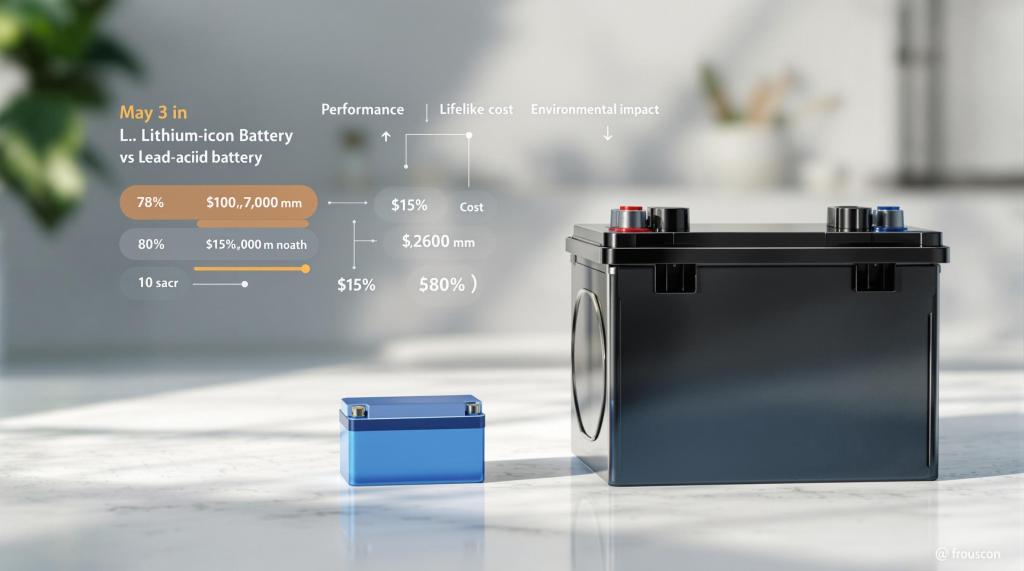
Looking for the right battery for your off-grid system? Here’s the quick breakdown:
- Lithium-Ion: Lightweight, fast charging, long lifespan, steady power output, higher upfront cost.
- Lead-Acid: Affordable upfront, heavier, slower charging, shorter lifespan, requires regular maintenance.
Quick Comparison
| Feature | Lithium-Ion | Lead-Acid |
|---|---|---|
| Weight | ~55% lighter | Heavier |
| Lifespan | 10–15 years, up to 10,000 cycles | ~5 years, 500–1,000 cycles |
| Power Consistency | Remains steady | Drops during discharge |
| Charging Speed | 1–2 hours | Slower, ~6–8 hours |
| Temperature Range | -4°F to 140°F (discharge) | Loses capacity in extreme temps |
| Maintenance | Minimal | Regular checks and upkeep |
| Cost per kWh | $300–$500 | $100–$200 |
| Recycling Rate | 5% | 99% |
Bottom line: Lithium-ion batteries are ideal for long-term performance and demanding conditions, while lead-acid batteries are better for low-budget, short-term needs. Let’s dive deeper into the details.
How They Perform
Weight and Power Output
According to a PowerTech Systems study, the PowerBrick+ 100Ah lithium-ion battery weighs just 13.6 kg (30 lbs), compared to the hefty 40 kg (88 lbs) of the Trojan 12V lead-acid battery. This weight difference makes lithium-ion batteries a much better choice for mobile setups.
Another key factor is power consistency. Lithium-ion batteries deliver steady output throughout their discharge cycle, while lead-acid batteries lose power as they drain.
| Performance Metric | Lead-Acid (Trojan T1275-AGM) | Lithium-Ion (PowerBrick+ 100) |
|---|---|---|
| Weight | 40 kg (88 lbs) | 13.6 kg (30 lbs) |
| Size | Larger | 1.8x smaller |
| Power Consistency | Drops during discharge | Remains steady |
| Usable Capacity | 80Ah @ C0.5 rate | 100Ah @ C0.5 rate |
Now, let’s look at how these batteries compare when it comes to charging speed.
Charging Speed
Lithium-ion batteries are far more efficient at charging, with an efficiency rate of about 99%, whereas lead-acid batteries fall short in this area. Modern NMC (Nickel Magnesium Cobalt Oxide) lithium-ion cells can fully charge in about an hour at a 1C rate. On the other hand, LFP (Lithium Iron Phosphate) batteries typically take 1.5 to 2 hours to fully charge.
Unlike lead-acid batteries, lithium-ion batteries don’t require equalizing or saturation charges, nor do they need complex charging circuits. This simplicity makes them an excellent option for solar power systems, which often deal with unpredictable charging conditions.
But charging isn’t the only factor – weather can also have a big impact on battery performance.
Weather Effects
When temperatures drop to 32°F, lead-acid batteries lose 20% of their capacity; at -22°F, they lose a staggering 50%. Additionally, every 10°F increase in temperature cuts their lifespan in half. In contrast, lithium-ion batteries are far more adaptable. They can operate between -4°F and 140°F during discharge and between 32°F and 113°F while charging.
However, lithium-ion batteries still require some care in extreme conditions. For instance, in cold weather, using battery blankets, avoiding fast charging, and storing them in temperature-controlled spaces can help maintain performance. Regular cleaning also helps reduce stress caused by temperature fluctuations. Despite these precautions, lithium-ion batteries generally handle diverse weather conditions more reliably.
These factors make lithium-ion batteries a strong choice for off-grid and outdoor applications where weight, charging speed, and weather resilience are critical.
Life Expectancy
Usage Cycles
Lithium iron phosphate (LFP) batteries last much longer than traditional lead-acid batteries, handling anywhere from 1,000 to 10,000 cycles before showing significant wear. In comparison, lead-acid batteries usually manage only 500 to 1,000 cycles.
| Battery Type | Cycles | Lifespan | Usable Capacity |
|---|---|---|---|
| Lithium Iron Phosphate (LFP) | 1,000-10,000 | 10-15 years | 80-100% |
| Standard Lithium-ion (NMC) | 500-1,000 | 10+ years | 80-100% |
| Lead-acid | 500-1,000 | ~5 years | 30-50% |
Temperature and usage patterns also influence performance. Research from WattCycle indicates that LiFePO4 batteries perform reliably across a wide temperature range (-4°F to 158°F), while lead-acid batteries can lose up to half their capacity in hot environments.
"When exposed to low or high temperatures, the chemical processes inside the battery can slow down or become erratic, reducing both its power output and its ability to hold a charge." – Cycle Watt, WattCycle-US
Upkeep Needs
Maintenance plays a key role in extending battery life. Lithium-ion batteries generally require less upkeep, focusing on:
- Managing storage temperatures
- Keeping charge levels between 25-80%
- Avoiding extreme temperatures
- Basic cleaning to prevent buildup
On the other hand, lead-acid batteries need more attention, such as:
- Regular checks for damage and corrosion
- Following strict charging protocols to avoid sulfation
- Ensuring proper ventilation during charging
- Monitoring and refilling electrolyte levels frequently
Lead-acid batteries are less efficient, wasting about 15% of input energy and suffering permanent capacity loss when only partially charged. Lithium-ion batteries, however, benefit from partial charging. Research shows that slightly reducing the peak charge voltage by 0.10V can double their cycle life. For storage, keeping lithium-ion batteries at around 50% charge helps prevent capacity loss.
LiFePO4 batteries also come with built-in temperature protection systems to prevent overheating and reduce fire risks. In contrast, lead-acid batteries lack these safeguards, requiring external systems to monitor and manage environmental factors.
Lead-Acid Vs Lithium (LiFePO4) Batteries for Solar Power
sbb-itb-0f2357b
Price Comparison
When comparing batteries for hybrid power systems, cost differences play a key role alongside performance and lifespan.
Purchase Price
Lead-acid batteries are priced at $100–$200 per kWh, while lithium-ion batteries range from $300–$500 per kWh. Although lead-acid options are cheaper upfront, their long-term value diminishes over time due to shorter lifespans and higher maintenance needs.
Here’s a cost breakdown for a typical 50 kWh system:
| Battery Type | Cost per kWh | System Cost (50 kWh) | Installation Cost | Transportation |
|---|---|---|---|---|
| Lead-Acid AGM | $100–$200 | $5,000–$10,000 | $2,000 | $1,000 |
| Lithium-Ion | $300–$500 | $15,000–$25,000 | $2,000 | $1,000 |
While lead-acid systems appear more affordable initially, operational expenses and replacement timelines can tip the scales.
Running Costs
Lithium-ion batteries shine in the long run due to reduced energy losses, minimal maintenance, deeper discharge capabilities, and longer lifespans. Research by Power Sonic highlights these factors, noting that lower operational costs lead to a better total cost of ownership.
"When choosing between battery options, a common question arises: ‘Are lithium batteries worth the higher cost?’ At first glance, lithium batteries may appear more expensive than lead acid batteries, especially when comparing batteries with similar capacity ratings. However, when you consider the total cost of ownership and performance advantages, lithium batteries can prove to be a more cost-effective option in the long run."
These advantages directly impact replacement frequency and overall savings.
Replacement Timeline
Over a 10-year period, the lifespan of a battery system greatly affects costs. Let’s look at a 200Ah battery bank example:
-
Lead-Acid Solution:
- Initial cost: $800
- Replacement frequency: Every 3–4 years
- Total 10-year cost: Around $2,400 (due to multiple replacements)
-
Lithium-Ion Solution:
- Initial cost: Under $1,000
- Replacement frequency: None within 10 years
- Total 10-year cost: Around $1,000 (single installation)
For larger systems, the difference is even more pronounced. Over 10 years, lead-acid systems may require six installations, totaling ~$60,000, while a single lithium-ion installation costs around $20,000. This translates to a cost per usable kWh per cycle of $0.42 for lead-acid versus $0.15 for lithium-ion.
Earth-Friendly Factors
When choosing batteries for hybrid power systems, it’s essential to consider the environmental impact throughout their lifecycle.
Recycling Options
Recycling rates vary significantly between different battery types. Lead-acid batteries top the charts with a 99% recycling rate, making them the most recycled consumer product in the U.S.. This is largely due to a well-established recycling network and a straightforward process.
In contrast, lithium-ion batteries lag behind with only a 5% recycling rate. Efforts are being made to improve this, as highlighted by Call2Recycle:
"On behalf of corporate stewards, we optimize collection, share our experience and responsibly manage the end-of-life of batteries and other material." – Call2Recycle
Here’s a quick comparison of the two:
| Aspect | Lead-Acid | Lithium-Ion |
|---|---|---|
| Recycling Rate | 99% | 5% |
| Infrastructure | Well-established | Developing |
| Process Complexity | Simple, standardized | Complex, varied chemistry |
| Collection Systems | Widespread | Limited |
These differences highlight the challenges lithium-ion batteries face compared to the streamlined recycling and manufacturing processes for lead-acid batteries.
Manufacturing Impact
The production of lead-acid batteries has a much smaller carbon footprint compared to lithium-ion batteries, which generate around 73 kg CO2-eq/kWh. This is primarily due to factors like cell production, active materials, and aluminum components. Here’s the breakdown:
- Cell Production: Responsible for 20% of the emissions.
- Active Materials: Contribute 40% to the climate impact.
- Aluminum Components: Account for 17% of the carbon footprint.
A study by Battery Council International and the International Lead Association emphasizes the difference:
"The environmental impact of manufacturing a lead battery is four times less than manufacturing a similar lithium-iron phosphate (LFP) battery."
Lead-based batteries also produce 39%-90% fewer emissions during manufacturing compared to lithium-iron phosphate batteries. Additionally, recycling lead results in 99% lower CO2 emissions per 100,000 tons compared to mining virgin ore.
The location of manufacturing and the energy sources used play a big role in the environmental impact. For instance, lithium-ion batteries made in China, where coal dominates electricity generation, have a much higher carbon footprint.
These factors are critical when weighing the environmental trade-offs for outdoor power systems.
Conclusion
Main Differences
Lithium-ion and lead-acid batteries differ greatly in performance and lifespan. Lithium-ion batteries can store about 50% more energy per unit and last through up to 8,000 cycles, while lead-acid batteries typically manage around 500 cycles. These differences make each battery type suitable for specific uses:
| Feature | Lithium-Ion | Lead-Acid |
|---|---|---|
| Energy Density | 150 Wh/kg | ~50 Wh/kg |
| Lifespan | 15–20 years | 3–5 years |
| Price Range (2023) | $75–$250/kWh | $50–$150/kWh |
| Self-Discharge Rate | Much lower | Higher |
| Maintenance Needs | Minimal | Regular checks |
Best Uses
Lithium-ion batteries are perfect for off-grid setups, thanks to their fast charging, efficient energy storage, lightweight design, and compact size. They’re particularly well-suited for remote surveillance, marine applications, portable power, and leisure vehicles. On the other hand, lead-acid batteries are a better choice when low upfront costs are a priority.
Learn More with Live Outdoors

Check out Live Outdoors for expert advice on choosing the right outdoor power solutions.
Related Blog Posts
- The complete review of the Laveo Dry Flush Portlable Toilet
- How to Install Hybrid Power in Caravans
- Best Hand-Crank Chargers for New Zealand Outdoors
- Top 5 Battery Expansion Packs for Caravans 2025
https://app.seobotai.com/banner/banner.js?id=67c4f40d6c9ebce91891ecae
 Live Outdoors